
Witness to Life: The Corotú Tree That Changed the Way I See
The urge to return
I returned to that place two days later, drawn by something difficult to explain. Beneath a corotú tree, surrounded by changing light and quiet shapes, I found a moment that would transform the way I see.
I don't remember the last time I had taken out my camera to take photographs. But that afternoon, at a time when many things were changing, especially professionally, I felt a kind of impulse.
I was with a friend in an open field surrounded by trees, grass, and nature. Sitting beneath a bohío, we watched the rain fall onto every leaf and disappear into the plants around us. It didn't last long, as is often the case in Panama. The rain moves quickly, continues on its way, and leaves everything looking different for a few minutes.
When it stopped, I found myself looking into the distance. I began noticing things I hadn't seen before.
I felt something and told my friend I would come back with my camera.
The corotú as a witness
Two days later, at six in the morning, I returned to the same place.
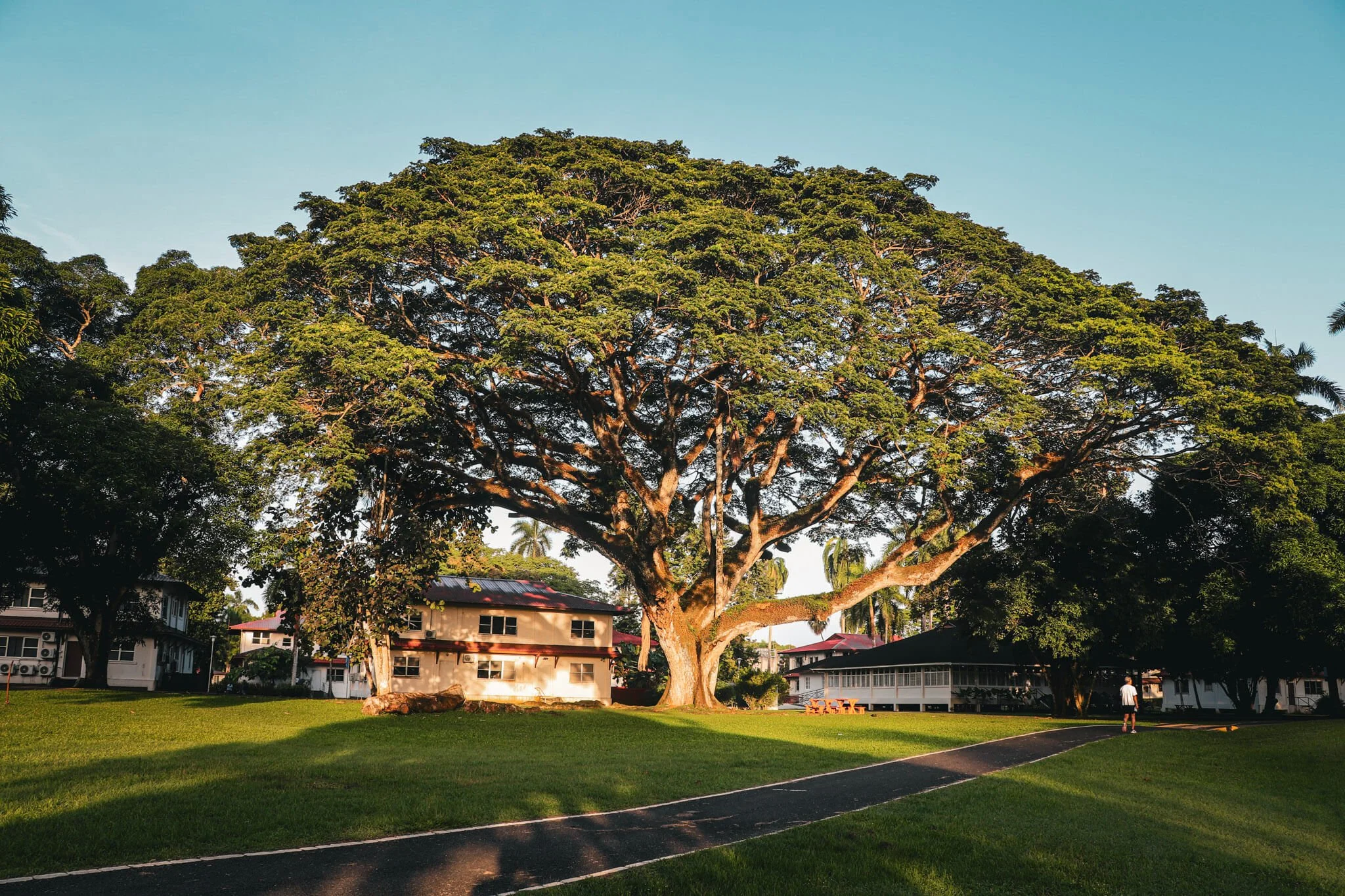
There stood a large corotú tree, easily somewhere between 75 and 90 years old.
The corotú, scientifically known as Enterolobium cyclocarpum, is a large, majestic tree commonly found along Panama's Pacific region, particularly in pastures, open areas, and secondary forests. In Panama, we know it as corotú, although elsewhere in the region it is also known by names such as guanacaste, conacaste, caro caro, parota, and orejón.
Its presence is imposing. It can grow to impressive dimensions, with a broad canopy that provides shade and a strong trunk that seems to hold memories. Its curved fruit resembles an ear, which explains some of its common names throughout the region, including orejón and elephant-ear tree.
I felt that this tree had witnessed many things, and something about its presence made me look beyond what was immediately in front of me.
One life beside another
The morning moved on.
Birds arrived. People came to exercise. The light changed as the sun continued to rise. Everything began turning into shapes, shadows, and textures.
Beside the tree stood a palm of a similar size. I had the feeling that they had grown together like a married couple: different, but connected. Supporting one another, understanding their differences, but also understanding that both needed to grow. Each in its own space, yet together.
At first, I kept my distance. I walked around them, looking for different perspectives.
Little by little, the tree began drawing me closer. I approached it, wanting to capture in greater detail everything that was happening around it.
The moon between the branches
When I was standing directly beneath it, between the trunk of the corotú and the palm, I looked up.
Against a canopy of green and a blue sky, the moon appeared right in the center.
For a moment, it almost didn't feel real.
I was captivated.
Eventually, it was time to leave. I felt peaceful knowing I had returned to that place with my camera.
I didn't know it then, but that moment beneath the tree would mark an unexpected turning point for me.
This tree can be found at Ciudad del Saber, Clayton, Panama, behind Casa Museo.
If you'd like to see more photographs from the Witness to Life series, you can explore the complete project here:
